Recommendation 1 requires Ambulance Victoria to ensure its Executive has a clear understanding of reflective practice and how it will support leadership’s understanding of the drivers of workplace inequality.
It requires the CEO and Executive to develop and implement a plan for reflective practice discussions to occur in teams throughout the organisation. Recommendation 1, along with Recommendation 41: Board learning through reflective practice and Recommendation 42: Organisational healing and cultural change through reflective practice, seeks to embed reflective practice as a tool to embed learnings from Phase 1 of the Review.

It is the responsibility of the Ambulance Victoria CEO and Executive to ensure that all staff are safe and included when they come to work. Reflective practices will underpin Ambulance Victoria’s ongoing commitment to healing, continuous workplace equality improvement and embedding of learnings from Phase 1 of the Review.
The reflective practice process will support Ambulance Victoria to comply with the positive duty under the Equal Opportunity Act 2010 (Vic) to prevent and respond to discrimination, sexual harassment and victimisation. See chapter 3.2 of the Phase 1 Report.
The Phase 1 Report identified significant leadership and management deficiencies at Ambulance Victoria. Specifically, it found inadequate role modelling by managers and a historical preference for autocratic leadership, which has exacerbated gaps in managerial capability and willingness to address unlawful or harmful workforce conduct. For further information see section 6.1.4 of the Phase 1 Report.
In 2021 the Executive and other senior leaders participated in initial reflective practice workshops run by ZALT Group. These workshops focused on the learnings from Phase 1 of the Review and workshop outcomes contributed to the development of the Your AV Roadmap (which influenced the current Your AV Roadmap – Outcomes Focussed Model).
A reflective practice framework (designed by Andrew Hollo of Workwell) was created in May 2023 and used in four Board reflective practice dialogues. The framework continues to be used at Board and Executive levels, and is planned to be used across the organisation when reflective practice is rolled out broadly at Ambulance Victoria.
The aim of this workshop in April 2024 was to familiarise the senior leadership team with the reflective practice framework and how to use it to share learnings and promote an organisation-wide commitment to continual improvement.
The Commission heard that reflective practice was beginning to be a part of senior leader meetings, but was not yet being undertaken by team leaders. During the Progress Evaluation Audit, many people acknowledged that reflecting on practice was common throughout the organisation at all levels, but reflective practice is not yet commonly used as a tool to better understand workplace equality in Ambulance Victoria.
ParticipantI think we've done it well in the clinical space for some time. But I think if we're talking about this specifically in the context of the Review … I don't think we've done anything in our frontline leadership. I think it's gone to director level and probably to be fair we've had one exercise around that at a leadership forum, which was good, and I think there was actually quite a good session, but I don't believe anything has been done at our area manager level in the operations space.

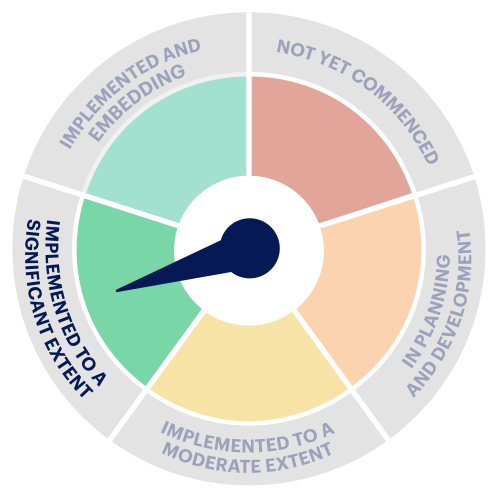
The Commission has found that Recommendation 1 has been implemented to a significant extent.
This acknowledges the work around reflective practice at senior leadership levels, but recognises the need to extend this to all levels of the workforce to provide an opportunity for listening, which will support behaviour and attitudinal change.
The Commission understands the implementation of the reflective practice plan and framework (related to workplace equality) will be undertaken by the Your AV Steering Committee in 2025.
The Commission encourages Ambulance Victoria to continue implementing Recommendation 1 by embedding reflective practice as business as usual at all levels of leadership and to consider including reflective practice in leaders’ performance goals. A participatory approach to reflective practice would be a useful feature of the approach so as to assist in promoting the Reform Enabler: Harnessing workforce commitment.
The reflective practice process at Ambulance Victoria would benefit from communicating of the clear causal links between reflective practice discussions and tangible change outcomes. See Reform Enabler: Enhancing communication and Reform Barrier: A focus on compliance over intent in change management.