Recommendation 20 requires Ambulance Victoria to work with the Department of Health and other stakeholders to establish benchmarks to measure its report and complaint system performance.

Ongoing monitoring and evaluation of an organisation’s report and complaint system – supported by specific benchmarks related to measures of timeliness, outcomes, remedies and causes – will assist to ensure Equal Opportunity Act 2010 (Vic) compliance as well as adherence to leading practice and continuous improvement. For an organisation of Ambulance Victoria’s size, the Commission considers this to be a reasonable and proportionate measure to eliminate discrimination, sexual harassment and victimisation.
Measuring the performance of Ambulance Victoria’s report and complaint system will establish datasets that will assist in identifying root causes, trends and drivers of harmful and unlawful behaviour. This will underpin continuous improvement in Ambulance Victoria’s approach to managing reports and complaints.
In Phase 1 of the Review, the Commission found that while data about Ambulance Victoria’s report and complaint system was being collected across a range of issues, the reporting in use did not analyse the root causes of reported behaviour or detail trends over time. This resulted in missed opportunities to address the drivers and risk factors of issues, and to prevent harm in future. See section 9.5.1 of the Phase 1 Report.
Understanding people’s experiences of a report and complaint system – for example, via satisfaction surveys – is a vital quality indicator. Research suggests that the effectiveness of report and complaint systems can be best measured by whether they are perceived to be fair, which provides a better measure than other potential indicators. See section 9.5.1 of the Phase 1 Report.
Ambulance Victoria is approaching implementation of this recommendation by collecting data against quantitative and qualitative performance measures between April 2024 and March 2025 to establish the baseline performance of its report and complaint system. Ambulance Victoria intends to use the baseline performance data to develop performance benchmarks in 2025.
The Commission found that in developing the quantitative and qualitative performance measures that are currently being used to determine baseline performance of the report and complaint system, Ambulance Victoria has followed best practices including process mapping and participant surveys, as well as seeking advice from the Commission. The Commission considers that this approach will support well-informed benchmark development in 2025.
The Commission understands that Ambulance Victoria intends to consult with the Department of Health and health sector to inform leading practice in 2025. This will enable Ambulance Victoria to better understand common issues experienced across the health and emergency services sectors, and to contextualise its own data.

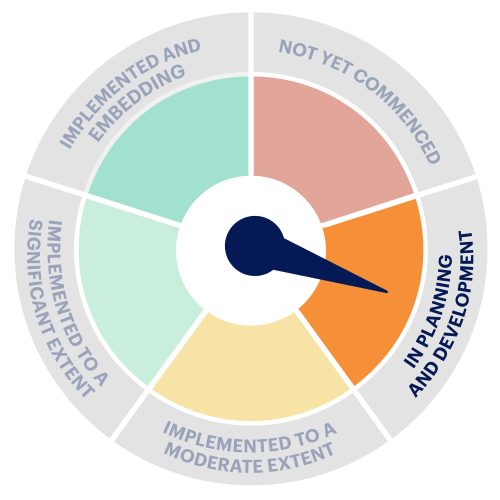
Given benchmarks to measure the performance of the report and complaint system will be developed in 2025, Ambulance Victoria’s work towards implementation of this recommendation is in the planning and development stage.
Regular measuring of the report and complaints system’s effectiveness through benchmarks will support continual improvement of Ambulance Victoria’s report and complaint system in line with leading practice.
Once developed, these benchmarks will present significant opportunities to engage the enablers of reform. Transparency in processes creates a culture of shared responsibility, which is a crucial aspect of the Reform Enabler: Harnessing workforce commitment.
Throughout the Progress Evaluation Audit, the Commission found that many complaints received by the Professional Standards and Behaviours Department related to low-level incivility and should be resolved locally. Sharing accountability for these complaints – including accountabilities for resolving them at a local level without further escalation – is therefore a key element of the Reform Enabler: Utilising distributed leadership.
Working with key stakeholders in the health sector will also positively impact the existing Reform Barrier: A focus on compliance over intent in change management. Examples of positive change management can be seen in hospitals that have undergone radical structural change in recent years, including the Royal Melbourne Hospital.