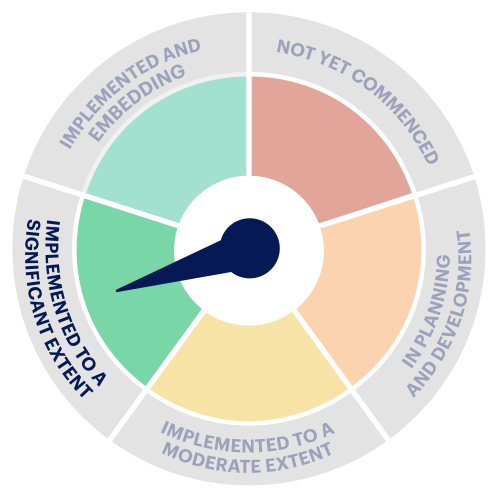
Recommendation 15 requires Ambulance Victoria to set up and promote internal and external anonymous reporting pathways.

Anonymous complaint pathways can:
address power imbalances
address barriers to and encourage reporting
foster understanding of the true nature of unlawful conduct that may otherwise remain hidden.
* See Recommendation 8: Encouraging a ‘speak-up’ culture, Recommendation 13: A victim-centred and fair report and complaint system, Recommendation 14: Enhancing perceptions of independence and supporting capability for the new organisational response to reports and complaints of unlawful conduct, Recommendation 16: Embedding a victim-centred approach to processes and procedures, Recommendation 18: Developing resources to support accessibility of the report and complaint system, Recommendation 20: Understanding how the report and complaint system is working, Recommendation 21: Learning lessons and improving service delivery at the earliest opportunity and Recommendation 23: Supporting the effective delivery of reporting and complaint reforms.
For large organisations, anonymous reporting systems are a key element of effective complaint processes. During Phase 1 of the Review, the Commission found a low rate of bystander reporting (see section 7.3 of the Phase 1 Report), fuelled by a culture of silence and fear of victimisation (see sections 6.1.2 and 8.2 of the Phase 1 Report).
The Commission found that Ambulance Victoria’s then Complaints Policy allowed for ‘confidential complaints’ managed by the (then) Professional Conduct Unit or an external agency, bypassing the complainant’s manager. However, the Commission found that using the term ‘confidential complaints’ in this context was confusing for the workforce as it did not include anonymous reporting and suggested managers should handle complaints confidentially despite inherent confidentiality limits.
Members of the workforce could make anonymous complaints to an external law firm. However, this pathway was not well-promoted or included in Ambulance Victoria’s policies, potentially creating barriers due to perceived conflicts of interest or fear of punitive responses.
In March 2023 Ambulance Victoria engaged a third-party provider to establish and administer an external anonymous-reporting tool.
On 5 June 2023, the AV SpeakUp report and complaint service was launched. As part of the AV SpeakUp service, complainants can choose to remain anonymous. Complaints made via AV SpeakUp are managed through Ambulance Victoria’s Complaints Policy (POL/PAC/070).
The new service was promoted to employees and volunteers via key internal communication channels.
As well as AV SpeakUp, there are options to make internal anonymous complaints through the Professional Standards and Behaviours Department (PSBD) phone line, PSBD email or ordinary mail.
In data provided to the Commission by Ambulance Victoria during the Progress Evaluation Audit, 61 reports or complaints were made through AV SpeakUp in the period between the 5 June 2023 launch and 31 March 2024:
This was reported to represent around 15% of all reports and complaints received by PSBD.
The top 3 complaint categories in this period were: bullying and harassment; unethical conduct; and other breaches of policy.
80% of reporters remained anonymous.
Approximately half (47%) of workforce survey respondents reported being familiar with AV SpeakUp. A further quarter (24%) were aware of the service but not familiar with the details, while 28% were not aware of AV SpeakUp at all. Familiarity was lower among part-time and casual staff.
Only 13% of survey respondents reported they were confident in AV SpeakUp. In addition, only 28% said they would be likely to use the service if they experienced harmful or unlawful conduct (37% in the case of witnessing conduct). There was some variability in confidence in AV SpeakUp by role – these differences are highlighted in the below graph.
It can be inferred from the different data sources that perceptions about vexatious complaints may be impacting workforce confidence in the system. Similarly, low levels of broader trust in the organisation may also be having a negative impact on confidence and/or willingness to report through AV SpeakUp.
During data collection for the Progress Evaluation Audit, the Commission heard from members of the workforce that they believe AV SpeakUp is being used by some to take advantage of anonymity to make vexatious complaints. While the Commission was unable to find clear evidence of vexatious complaints, even the perception of them has negatively impacted people’s perceptions of the integrity of the system and their trust in the process.
Ambulance Victoria senior leadership noted that, while the potential for ‘weaponisation’ of the complaints process is a difficulty, protecting whistleblowers’ anonymity is a priority.
Research evidence suggests that in the health sector, vexatious complaints are relatively rare; however, identifying vexatious complaints can also be difficult given the complainant’s motivation is often concealed.[25] Although the actual incidence of vexatious complaints may be low, the emotional and reputational impacts on the person who is the subject of a vexatious complaint can still be significant.[26]
During the Progress Evaluation Audit, Ambulance Victoria senior leadership told the Commission that all anonymous complaints made through AV SpeakUp are assessed in the same way as any other complaint made directly to the PSBD, so that only complaints that meet established criteria are progressed further.
[25] Rachel Canaway, Jennifer Morris and Marie Bismark, Reducing, identifying and managing vexatious complaints: Summary report of a literature review prepared for the Australian Health Practitioner Regulation Agency (2017).
[26] ‘Australian Health Practitioner Regulation Agency – Vexatious notifications’ <https://www.ahpra.gov.au/Notifications/How-we-manage-concerns/Vexatious-notifications.aspx>.

The Commission found that this recommendation has been implemented to a significant extent. The establishment and promotion of anonymous complaint reporting pathways at Ambulance Victoria are important parts of enabling a culture where people can speak up safely. Speaking up allows the organisation to identify trends and potential hotspots for unlawful and harmful behaviours.
Some further work is required to ensure that confidence and trust in the system continue to be built and maintained, so that the intent of the recommendation can be fully realised.
During the Progress Evaluation Audit, senior leaders from Ambulance Victoria told the Commission that part of the organisational reform journey is building confidence in AV SpeakUp. There are opportunities for Ambulance Victoria to improve awareness of, and confidence in, AV SpeakUp generally and by addressing concerns around vexatious complaints.
These opportunities could be pursued through:
addressing vexatious complaints in the organisation’s Complaints Policy and Codes of Conduct, stating they cause harm and are not tolerated at Ambulance Victoria, and also outlining the process that would occur if a complaint was found to be vexatious
further communication with the workforce on how the PSBD assesses complaints made through AV SpeakUp – to improve awareness and confidence (see Reform Enabler: Enhancing Communication)
describing in workforce communications the difference between vexatious and inadequate, incomplete or misconceived complaints – to build a common language across the workforce
reviewing complaint procedures and data collection with the view to identifying any additional measures that may assist in screening for potentially vexatious complaints.
Lastly, work to establish a culture of prevention is crucial for fostering a safe and supportive work environment. Encouraging employees to utilise the internal anonymous reporting service, AV SpeakUp, is a vital step in this process. See Reform Enabler: Building a culture of prevention.